
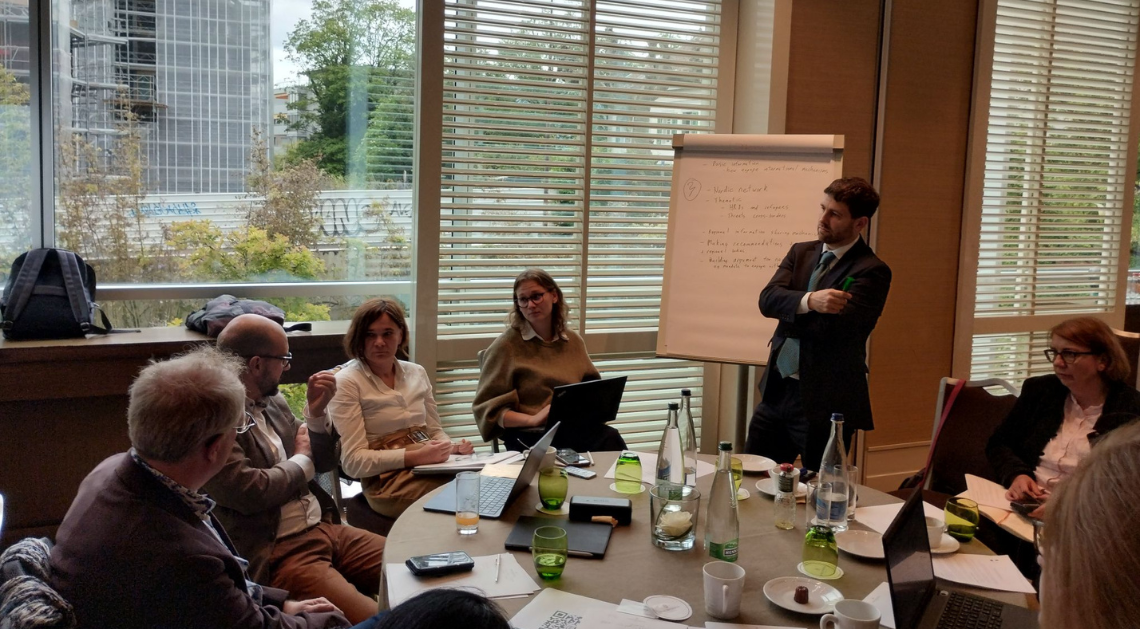
NHRIs exchange on strengthening their role in the protection of human rights defenders
In the context of increasingly deteriorating civic space and the worrying situation of human rights defenders (HRDs) in Europe, NHRIs met in Geneva earlier this year to exchange on their role, challenges, and avenues for strengthening their work to protect HRDs in Europe. A newly published outcome report summarises the key takeaways and key recommendations to ENNHRI.
The need for strengthening NHRIs
NHRIs undertake extensive work in monitoring, inquiring, investigating and reporting on human rights violations and threats faced by HRDs. Regionally, they are increasingly recognised as key actors in protecting HRDs in light of their role as bridges between HRDs, civil society, and the government. Building on the regional momentum, NHRI leaders from across Europe met in Geneva in May this year together with external stakeholders to discuss how to strengthen their role as protection mechanisms for HRDs.
As emphasised in the outcome report, the need for strengthening NHRIs’ role in protecting HRDs is more timely than ever. As also reported in ENNHRI’s 2024 report on the state of the rule of law in Europe, HRDs in Europe are facing increasing challenges when exercising their right to defend rights, including online and offline threats, intimidation, hate speech, smear campaigns and political pressure. This is compounded by legislative initiatives limiting their enabling space.
In this context, several protection needs identified by HRDs were presented. This included the need for support and solidarity, greater independent monitoring and reporting, as well as urgent action and increased coordination among actors involved in the protection of HRDs.
NHRIs’ key needs and recommendations to ENNHRI
Alongside detailing NHRIs’ existing work in protecting HRDs and building on discussions during the event, the outcome report outlines NHRIs’ key needs to step up their work in this area, including:
- The need to ensure an enabling environment to protect HRDs, including removing barriers to NHRIs’ independence and effectiveness when defending, supporting and promoting HRDs.
- The need for greater understanding, research and monitoring on HRD protection.
- The need for platforms and spaces to exchange on HRD protection, both nationally and regionally.
- The need for capacity building activities to strengthen HRD protection.
As a result, NHRIs shared key recommendations to ENNHRI. They include:
- ENNHRI can play a role as a platform for exchange and peer learning, as well as acting as a repository of resources for NHRIs with useful guidance and materials.
- ENNHRI can develop further capacity building and guidance for NHRIs, including strengthening their capacity to communicate more effectively on HRDs; create safe space and act as rapid response mechanisms; as well as supporting the development of NHRIs’ civic space monitoring methodologies.
- ENNHRI can ensure NHRIs act with a united voice at regional level, including by serving as a platform for joint advocacy at regional level, contributing to a model for a regional protection mechanism, and through developing common positions.
Read the outcome report to learn more on the key discussions and recommendation.
In addition, learn more on NHRIs’ work in ENNHRI’s resource on human rights defenders and the outcomes of ENNHRI’s workshop on the protection of environmental defenders.


