NHRIs come together to consider their role and functions in situations of armed conflict
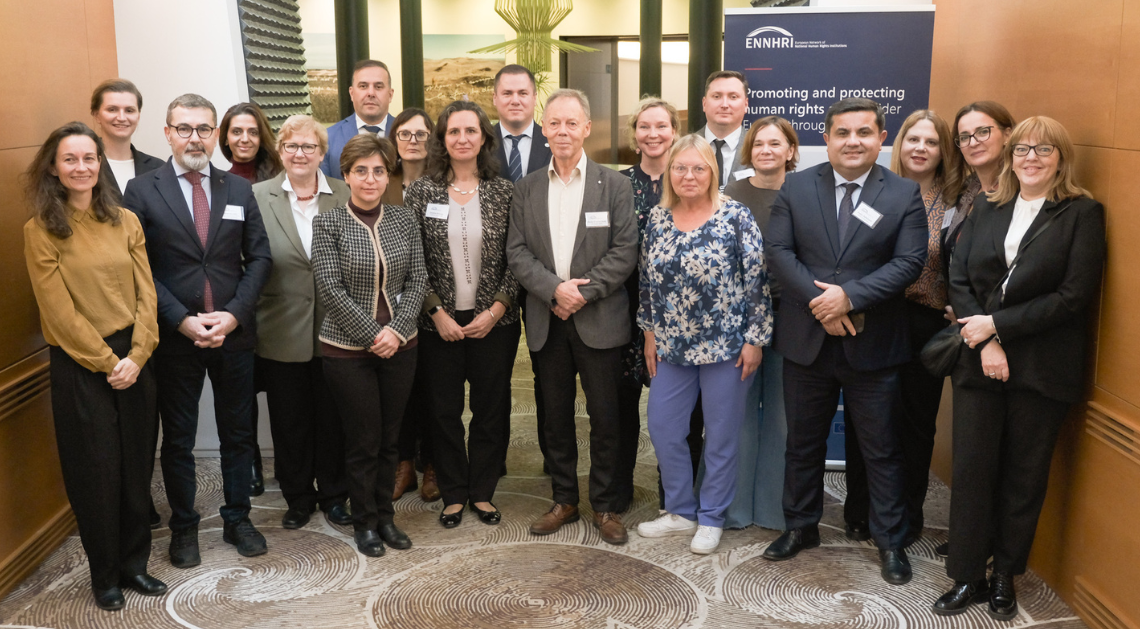
On 29-30 October 2024, ENNHRI convened representatives from 16 National Human Rights Institutions (NHRIs) in Brussels for a meeting on the role and functions of NHRIs operating in situations of armed conflict. Together they deepened their understanding of the multifaceted challenges NHRIs encounter during active and pre- and post-conflict situations, as well as possible ways to address these.
Sharing experiences on working in different conflict situations
Taking ENNHRI’s 2017-2020 project on NHRIs’ role in (post-)conflict situations as its starting point, participants engaged in an open dialogue on the difficult, diverse, and deep impacts of armed conflict on their operations.
Their accounts gave invaluable insight into the on-the-ground reality of protecting and promoting human rights in different conflict situations. This included practical challenges, such as working with internally displaced people, protecting the rights of minority groups, and access to territories outside of government control and areas of active fighting. The Ukrainian NHRI gave an in-depth presentation on its ongoing work in an active conflict.
Participants shared strategies, good practices, and experiences of adapting their roles under international human rights and humanitarian law. In small groups, they also explored particular aspects of their mandates. This included monitoring, documenting, and reporting on human rights violations, addressing individual complaints, and promoting human rights in conflict situations.
The international angle: relevant standards and cooperation with partners
The meeting also considered the role and relevance of international standards applicable to NHRIs. Primarily, participants focused on the impact of international human rights law and international humanitarian law on NHRIs’ work in armed conflicts and their cooperation with other entities and institutions – both within their own countries and internationally. They also considered the role of the UN Paris Principles, the SCA General Observations and other guidelines and declarations, such as the Kyiv Declaration and ENNHRI Guide on the Role of National Human Rights Institutions in (Post)-Conflict Situations.
Representatives from the Council of Europe, the United Nations Development Programme (UNDP) and the European External Action Service (EEAS) joined part of the discussions. Their perspectives on NHRIs’ role and functions in armed conflicts and possible cooperation between international organisations and NHRIs further enriched the conversation.
The meeting was an important step in fostering further knowledge, exchange and deepening ties between ENNHRI members and international organisations committed to human rights protection in conflict-affected areas.
Looking ahead and more information
Moving forward, the meeting’s insights and further consultations with members will shape ENNHRI’s work in this area. An ENNHRI scoping paper on NHRIs in armed conflict is set for publication in the near future.
Learn more about ENNHRI’s and NHRIs’ work on human rights in (post-)conflict situations, including the dedicated project.
Explore the ENNHRI Guide capturing the knowledge and outcomes of the 2017-2020 project.